A Lesson in Empathy
It's interesting how ideas sometimes arrive in clusters. Over the past few weeks, I've been thinking about downsizing, smaller homes and how needs change as people move through different stages of life. Those conversations prompted me to reflect on my own experience with downsizing, which I shared in this article. Little did I know they were also preparing me for a very different lesson the following week.
Last week, I attended a Blum Inspirations Workshop expecting to learn more about Blum's products and how I might use them in future projects. What I didn't expect was that the biggest takeaway would have very little to do with cabinetry hardware.
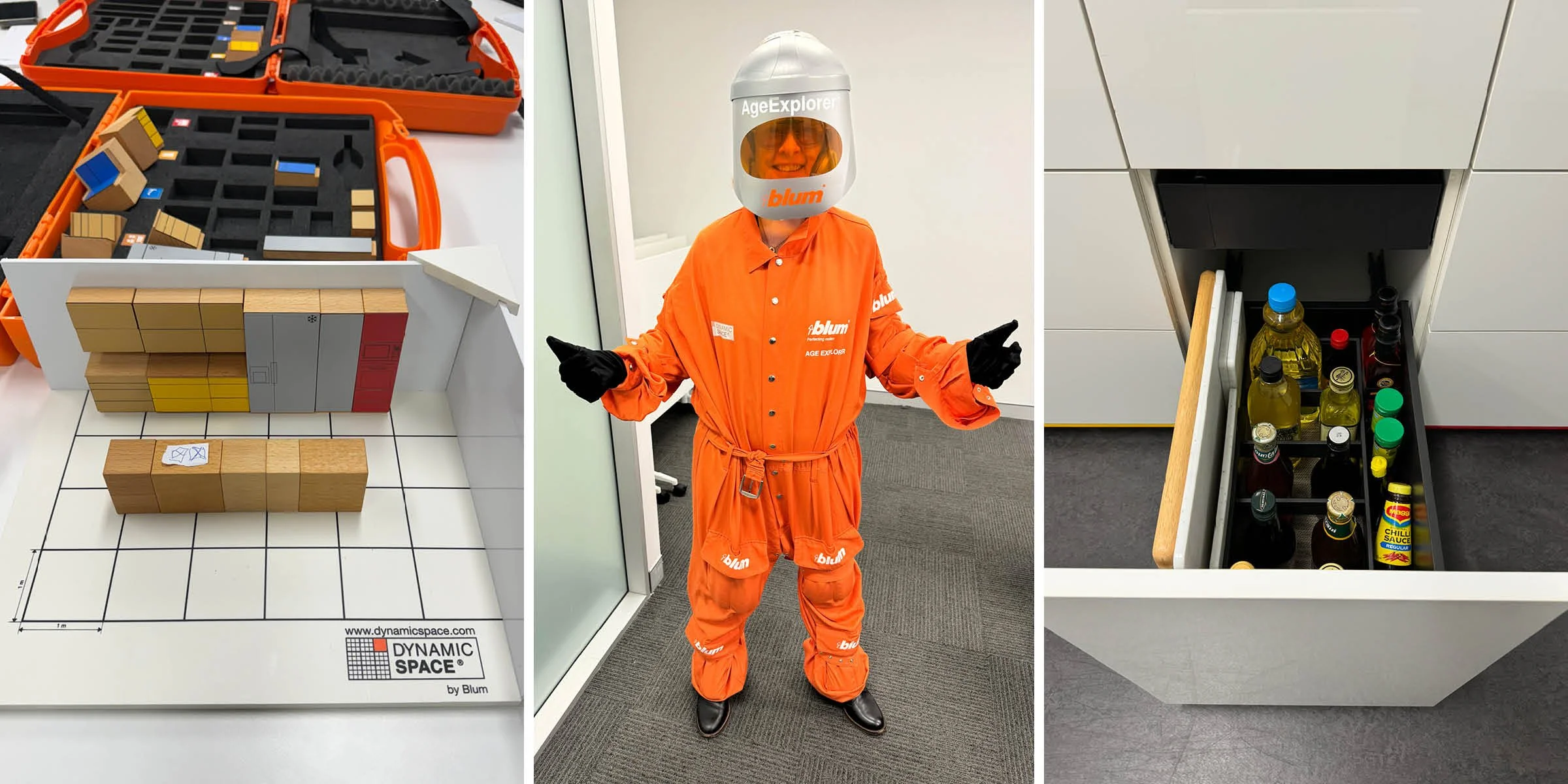
When the presenter asked for a volunteer to try the ageing simulation suit, I unwittingly put my hand up. It seemed like a bit of fun, and I was curious to experience it for myself. Within minutes, however, I realised this was much more than a demonstration. It was a sobering glimpse into how everyday tasks can become far more challenging as we age.
Before the tasks began, the presenter helped me into the ageing simulation suit, fitting each component one by one. It consisted of:
Braces that restricted movement in my knees and elbows.
An orange jumpsuit fitted over the braces.
Weights inserted into pockets on the shins, thighs, forearms and upper arms to simulate reduced strength and the extra effort required for everyday movement.
Gloves that reduced dexterity and grip strength, with a prickly lining to simulate arthritis.
Goggles that simulated cataracts and glaucoma.
Headphones that reduced hearing.
A helmet that restricted my peripheral vision.
My first task was to take a coin out of a wallet. To begin with, I couldn’t see the zipper to open it, nor could I feel the zipper. I had to try several compartments till I located the coin… and after that experience, I will never get impatient behind someone in the grocery line, fishing around in their wallet again.
The second task was to crouch down and pick out a blue paperclip from a mix of different coloured paperclips. At first, I spotted it straight away. But as I reached down, the colour seemed to change, and suddenly I couldn't find it again. Unsure whether I had the right one, I had to ask, "Is this the blue paperclip?"
We then moved into the showroom, where I was asked to take an item from an overhead cupboard and place it on the bench. Reaching up took more effort than I expected, but what surprised me most was trying to see where to put it down. On the second attempt, I found myself reaching for a mug instead of a glass, instinctively thinking that if I misjudged the bench, at least I wouldn't break it.
The final task was to retrieve an item from a base cupboard with hinged doors. Crouching down and trying to see into the back of the cupboard took a lot of effort, and even then it was difficult to see what was inside. It was a simple demonstration, but one that clearly illustrated why drawer storage can make everyday tasks so much easier because you can see everything at a glance without having to search for it.
Up until that point, the ageing simulation suit had been an engaging and, at times, mildly humorous demonstration. But somewhere between struggling to find a coin, reaching for a mug instead of a glass, and peering into a cupboard, the experience became something much more personal.
I found myself thinking about my dad and his Parkinson's disease. For me, the suit was a temporary exercise in empathy. For him, and for so many others whose daily lives are affected by disability, illness or ageing, those challenges are part of everyday life. In that moment, I caught a small glimpse of how frightening it must be to feel your body gradually becoming less able to do the things it once did so effortlessly.
The experience was a good reminder that good design begins long before selecting finishes or choosing colours. It begins by understanding the people who will use the space.
As designers, we have a responsibility to put ourselves in someone else's shoes and consider how they move through their home, where they might struggle, and how thoughtful design can quietly make everyday life that little bit easier. While I had always considered accessibility in my designs, the Blum demonstration deepened my understanding in a way that drawings and design guidelines never could.
I came to the workshop expecting to learn more about specifying joinery hardware. I left with a reminder that the best design decisions don't begin with a floor plan. They begin with understanding the people the space is being designed for.